
Personalised Resistance Training Consortium
From variability to precision in resistance training
An international research collaboration building the conceptual, methodological, and analytical foundations for personalised resistance training prescription practice — starting from a simple but overlooked idea: what is written on a training plan and what the body actually receives are not the same thing.
Framework
A prescription is not a dose
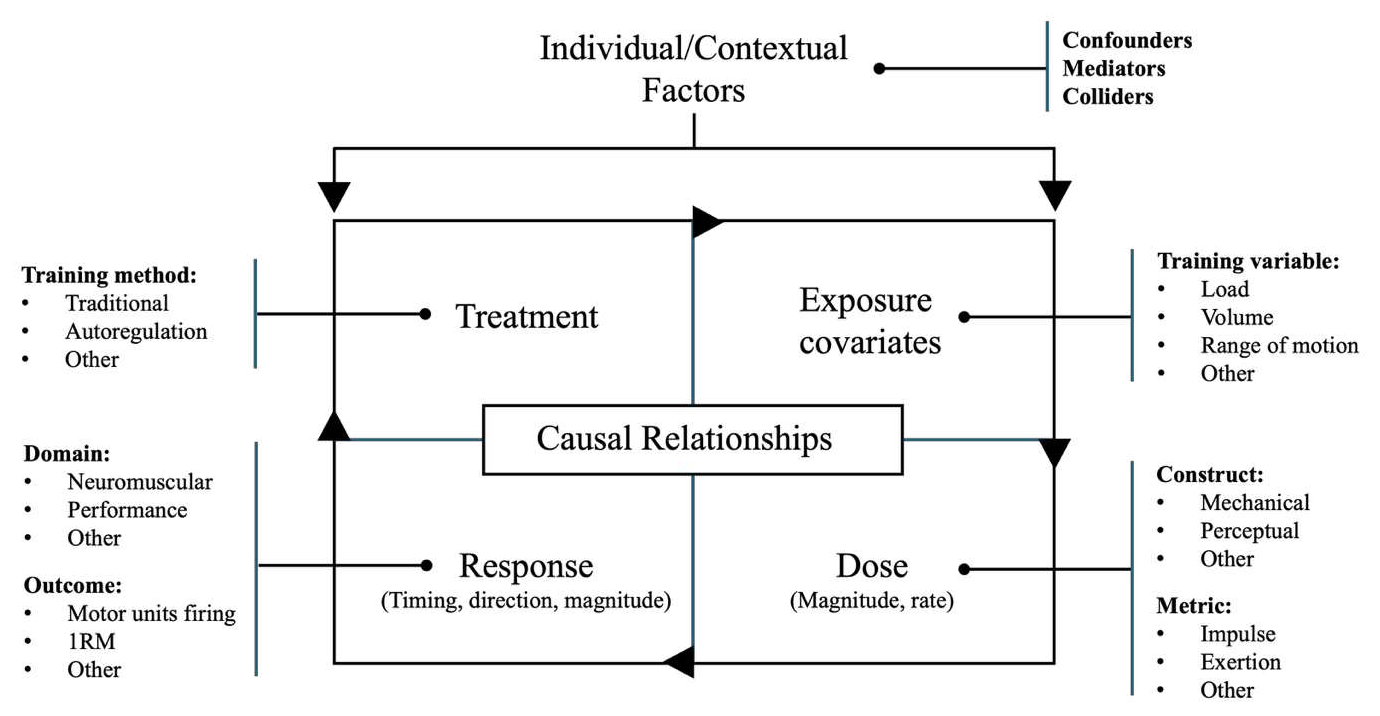
Two people being prescribed the same sets, reps, and load intensity scheme can experience a very different internal training stimulus. Resistance training research has long treated the numbers on a training plan as if they were the biological dose itself. We start from a different premise, borrowed from medicine and epidemiology: what is prescribed, what is actually performed, and the internal stimulus that drives adaptation are distinct steps in a causal chain — and each needs to be defined, measured, and studied on its own terms.
What is prescribed
The programme as written: sets, load, rest, tempo, and technique targets.
What is performed
The training actually completed on the day, including everything that deviates from the plan.
What the body receives
The internal mechanical, metabolic, and perceptual stimulus this creates — not directly observable, but inferable from valid and reliable proxies.
What follows
The acute and chronic adaptation that results, in both direction and magnitude.
What we work on
Four connected lines of work
Our work follows the treatment–exposure–dose–response pathway from conceptualisation through to practice.
Conceptual foundations
Clarifying what “dose” means in resistance training, and identifying valid proxies for a stimulus we cannot measure directly at the muscle level.
Trial design
Implementing appropriate study designs to investigate causal links along the treatment–exposure–dose–response pathway.
Analytical methods
Leveraging applied statistics to separate real, stable within– and between–individual delivered doses and responses from ordinary day-to-day noise and measurement error.
Autoregulation paradigm
Testing whether dynamically adjusting training to an individual’s current state — rather than to a fixed target — delivers a more consistent stimulus over time.
Who we are
Members
Meet the people leading and contributing to the Consortium’s work. Select a name to read their profile.
 Antonio Dello Iacono
University of the West of Scotland · Founding member
Antonio Dello Iacono
University of the West of Scotland · Founding member
[Edit: add a two-to-three sentence bio here — research focus, relevant background, and current role within the Consortium.]
 Ivan Jukic
Abertay University · Founding member
Ivan Jukic
Abertay University · Founding member
[Edit: add a two-to-three sentence bio here — research focus, relevant background, and current role within the Consortium.]
Paul Swinton
Robert Gordon University · Founding member
[Edit: add a two-to-three sentence bio here — research focus, relevant background, and current role within the Consortium.]
[Edit: new member name]
[Edit: institution · role]
[Edit: add a two-to-three sentence bio here. Copy this whole <details> block again for each additional member.]
How collaboration works
Project-led, open to contributors
Membership does not confer authorship — authorship on any output reflects meaningful contribution to that piece of work.
Propose
A member proposes a focused methodological or applied question in personalised resistance training.
Share
The Consortium helps identify collaborators with the relevant design, measurement, or analytical expertise.
Deliver
The working group conducts the study and disseminates the findings openly with the field. We are committed to open-science practice
Foundational work
Where the framework comes from
From Variability to Precision: A Conceptual Framework, Methodological Considerations and Analytical Approaches in Personalised Resistance Training Prescription
This paper sets out the treatment–exposure–dose–response framework, maps the sources of variability in delivered training dose, and shows why replicate crossover designs and variance-decomposition modelling are needed to support genuine personalisation. It forms the conceptual basis for the Consortium’s work.
Learning & outreach
Education
Opportunities to learn about and engage with personalised resistance training, for researchers, students, and practitioners.
Online workshops
Details coming soonPodcast episodes
Details coming soonPresentations & talks
Details coming soonConferences
Details coming soonJoin us
Get involved
We welcome researchers, students, and practitioners with an interest in resistance training methodology, measurement, or statistics — whichever part of the puzzle you work on. Tell us briefly about your background and what you’d like to contribute.
Apply to join- Propose a projectBring a focused methodological or applied question you would like to lead.
- Contribute expertiseOffer skills in trial design, measurement, statistics, or applied coaching to a developing project.
- Stay in the loopAsk to be added to our mailing list for updates on new projects and outputs.